
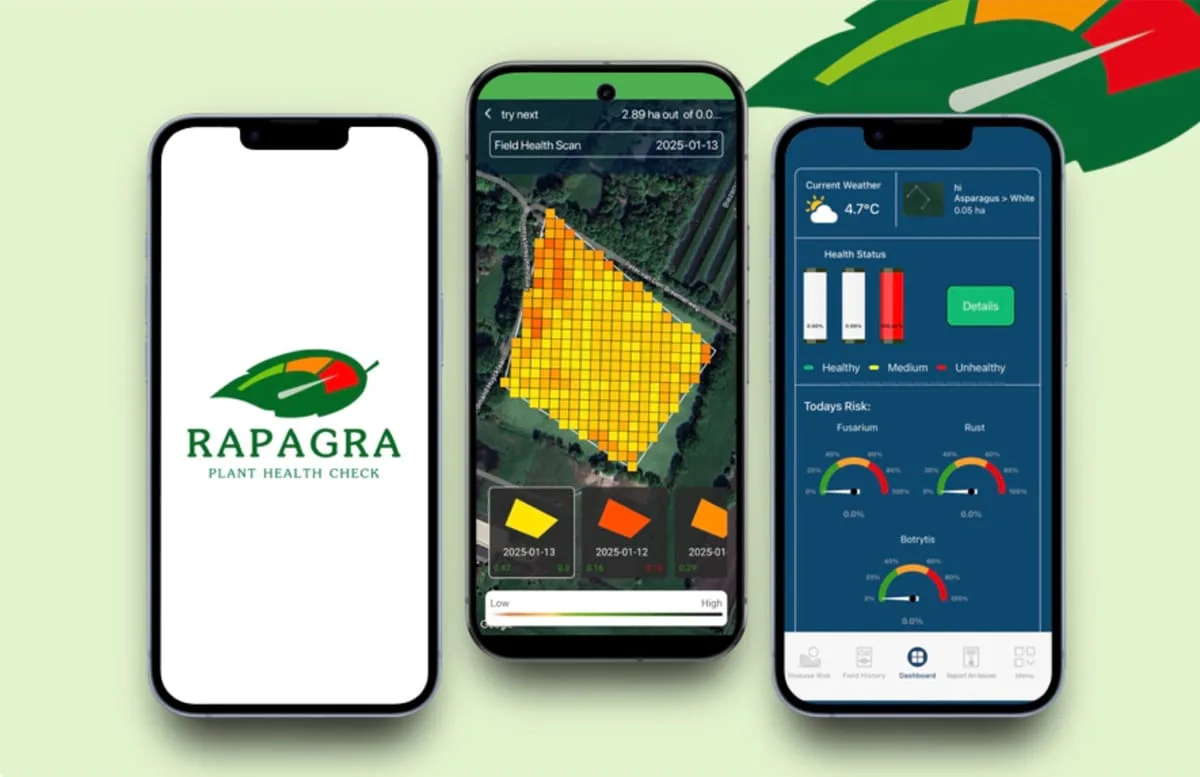
About the app
Modern growing is a constant fight against disease pressure. Threats like Phytophthora infestans can move through a potato field fast, and the usual answer is to spray everything, on a schedule, whether a plant needs it or not. That is expensive in product, labor, diesel, and environmental cost. Rapagra set out to replace blanket spraying with precision: show growers exactly where a field is healthy, where it is at risk, and where to act, before the damage is done.
OgreLogic designed and built the Rapagra mobile app that puts this intelligence in a grower's hand, in the field, on a phone.
The challenge
An agriculture intelligence tool only earns trust if it is both accurate and simple to use standing in a muddy field. The app had to turn field imagery and weather data into a clear health map, surface disease risk in terms a grower can act on, track how a field changes over time, and do all of it in an interface that is fast and readable outdoors. It also had to be reliable enough that a grower would base real spraying decisions on it.
What we built
We built the Rapagra app for iOS around the workflow a grower actually follows: scan, assess, decide. The core features include:
- A field health scan that maps a field as a color-coded grid over satellite imagery, so healthy, medium, and unhealthy zones are obvious at a glance, with a history of past scans by date.
- A dashboard that pulls in current weather alongside a per-field health status, broken into healthy, medium, and unhealthy shares.
- Today's risk readouts for specific threats such as Fusarium, Rust, and Botrytis, shown as simple gauges.
- Crop and plot selection (for example asparagus or potato plots) plus a report-an-issue flow, so observations from the field feed back into the system.
The impact
Rapagra gives growers a way to see disease pressure coming instead of reacting after a field is already hit. By pointing to the plants and areas most at risk, the app supports targeted treatment rather than blanket spraying, which is how it aims to save at least 30% in direct crop-protection costs along with labor and fuel, while keeping more yield in the ground. It is a clear example of practical technology built for a demanding, real-world job, and it is live now on the App Store.